

 Find a book


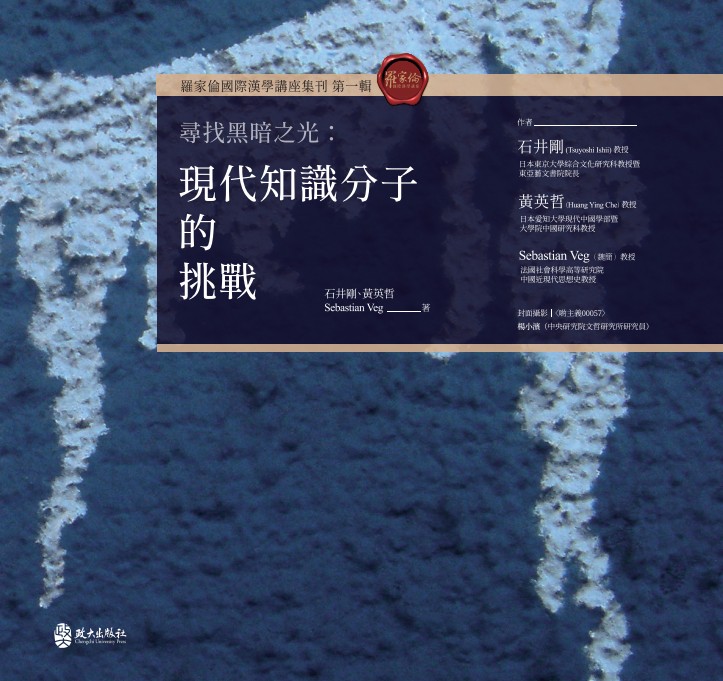
Title
Book Series of Office of Lo Chia-Luen International Sinology Chair, vol. 1 尋找黑暗之光 (Seeking Light in the Darkness - Challenges of Modern Intellectuals)
Size
390 pages, 15x21cm
Language
Chinese
Released
December, 2024
ISBN
9786267615065
Published by
National Chengchi University Press (Taipei)
Book Info
Japanese Page
We generally think of Chinese studies as the academic discipline of regional studies in contemporary China (the People’s Republic of China). However, the region known today as “China” has undergone repeated expansion and contraction, and is in the midst of a history in which various ethnic groups, religions, and languages have sometimes clashed and at others, merged. Looking back particularly at premodern times, this region has seen the rise and fall of many different ethnic groups who have placed the foundations of their common civilization in classics written in Chinese characters. Japan, located on the periphery of this region, once shared the ideals of the ancient world depicted in these classics as the origin of its own civilization. China thus does not simply refer to a sovereign nation today but also to a civilization that encompasses the dynamic and diverse history of transformation in this region.
Sinology is an academic field that studies the dynamism of this civilization (which could also be called the Sinitic world), incorporating classical studies. In Japan, it was once called Shinagaku, but after the establishment of the Republic of China in 1912, the term “Shina” was criticized as hindering understanding of the new China and even expressing contempt for it, and is no longer in use. Meanwhile, in today’s Chinese speaking world, Sinology is interpreted as “Hanxue.” Although Sinology has some overlap with Chinese regional studies, it is unique as an academic field that explores universality. This is because classical Chinese texts express scholarship and thought for a universal world.
This book is a record of a series of lectures given at the Lo Chia-Luen International Sinology Chair at National Chengchi University in Taiwan. As the title suggests, “Seeking Light in the Darkness: Challenges of Modern Intellectuals” is a specialized study of Sinology that, while focusing on the world of Chinese humanities, also attempts to address universal human challenges. David Der-wei Wang, who contributed the preface, reveals that the title was inspired by Hannah Arendt’s People in Dark Times. A common theme in the series of lectures was “Intellectuals in Critical Moments.” The series took place during the COVID-19 pandemic, and by the time of this book’s publication, the world had become increasingly confronted with crises, including violent international conflicts such as Russia’s invasion of Ukraine and Israel’s invasion of the Gaza Strip in Palestine, as well as worsening climate change. How can the wisdom of Sinology respond to these realities? In an attempt to do so, I have discussed the concept of “the space of Wen,” or the literary space. We hope that this work will be introduced in Japan in the future.
(Written by ISHII Tsuyoshi, Professor, Graduate School of Arts and Sciences / 2025)
Table of Contents
序 / 王 德威
未喪斯文,其如予何?──危機時刻的漢學研究 / 石井 剛
前言:「共生」的當代困境
第一章 「文」作為中國文史哲的整合觀念:孔子「文不在茲乎」和武田泰淳的文化反思
第二章 書寫實踐與靈魂的哲學:章太炎對清代漢學的繼承與《莊子》研究
第三章 在天地相接之處:從近年來中國「天下」討論看「文」的意義
第四章 我們的「危機」與「文」的希望:以《莊子‧人間世》為例
結語:文場─靈魂的傳遞與「後死之責」
「盡可能的微力,作些澆花的工作」:許壽裳、楊雲萍與戰後初期台灣研究的繼承與挪用 / 黃 英哲
前言:從楊雲萍的「澆花論」談起
第一章 陳儀、許壽裳、楊雲萍
第二章 陳儀的「理想」與「抱負」
第三章 許壽裳、楊雲萍與戰後初期台灣研究的開展
第四章 許壽裳、楊雲萍的挫折與成果
第五章 台灣省編譯館撤廢後台灣研究組工作人員去向
結論
「這個國家非垮不可」:楊基振的困境兼論台灣知識分子的「凱特曼」(Ketman)現象 / 黃 英哲
前言
第一章 關於楊基振
第二章 楊基振見證的危機時刻之一:「抗戰」與抗戰勝利後的華北接收
第三章 楊基振見證的危機時刻之二:「抗戰勝利」與「一九四九」
第四章 楊基振見證的危機時刻之三:中美斷交與80年代海外台灣人的「返鄉」
第五章 楊基振的中國之旅
第六章 結語
Intellectuals in Times of Unending Crisis: Reconsidering Intellectuals in 20th Century China / Sebastian Veg
Lecture 1 From Intellectual History to the Sociology of Knowledge and back: Studying Chinese Intellectuals in Global Perspective
Lecture 2 From Responsibility to Marginalization: Chinese Intellectuals in the 20th Century
Lecture 3 Minjian Intellectuals in the New Century: Alternative Forms of Knowledge and Participation